
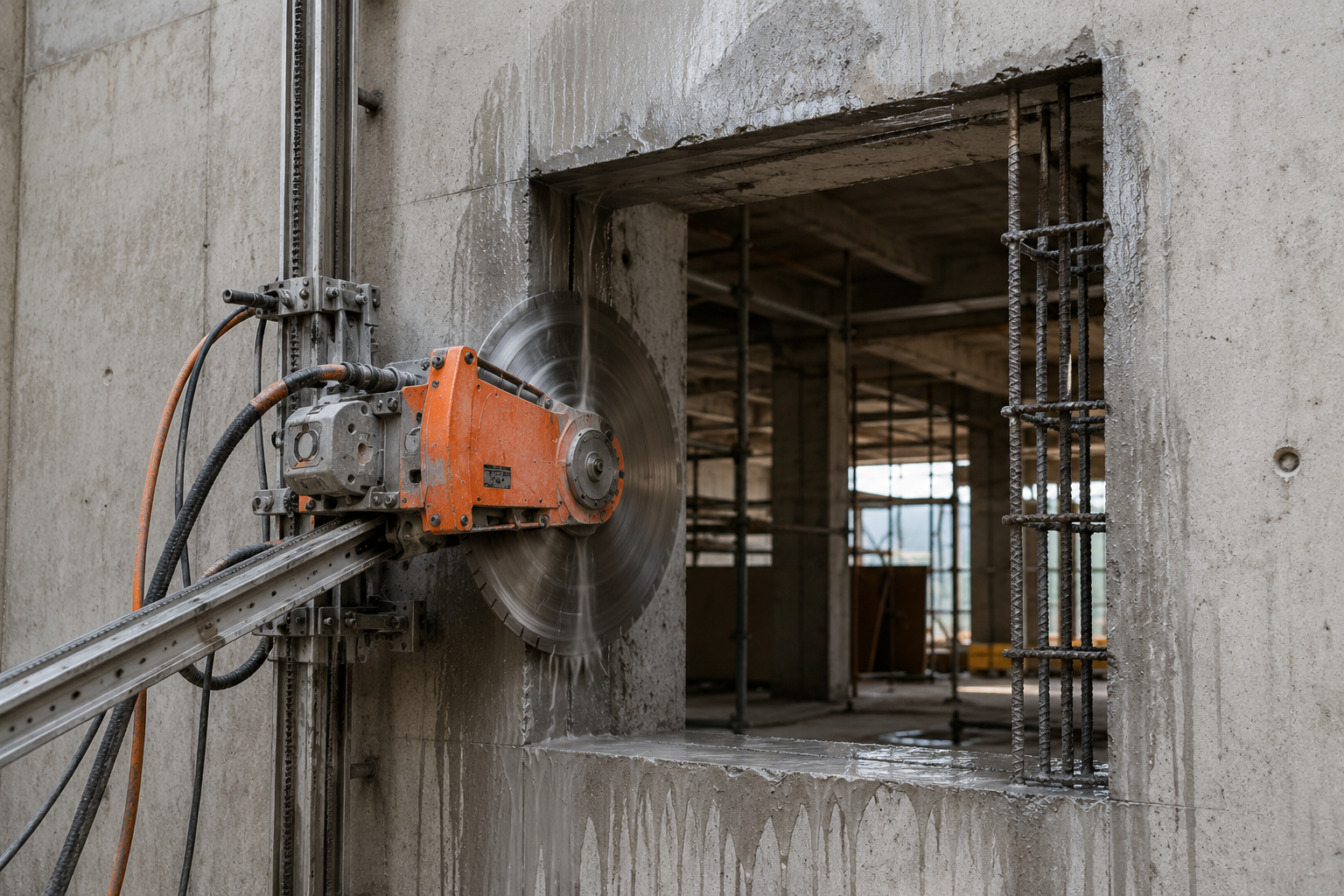
Wall sawing is one of the most precise methods used to modify concrete walls during construction, renovation, and infrastructure projects. Whether the objective is to create a new doorway, enlarge an existing opening, install a window, or remove a section of reinforced concrete, wall sawing provides the accuracy and control required for structural alterations.
Despite being a common service within the concrete cutting industry, many property owners are surprised when wall sawing quotations differ significantly from one project to another. Two openings may appear similar on a drawing, yet the cost of completing them can vary considerably once site conditions, reinforcement, wall thickness, and accessibility are taken into account.
This often leads to a common question: what exactly affects the cost of wall sawing?
The answer is that wall sawing is not priced according to a single fixed rate. Every project presents its own challenges, and those challenges influence the amount of planning, labour, equipment, and time required to complete the work safely and accurately.
Understanding these factors helps property owners budget more effectively, compare quotations with greater confidence, and make informed decisions before construction begins.
Get a Wall Sawing Quote for Your Project
Fill in the form below and receive a fast, no-obligation quote tailored to your wall sawing requirements.
Understanding What Wall Sawing Involves
Wall sawing is a specialised concrete cutting technique that uses a diamond blade mounted on a track-guided machine. The track is secured directly to the wall, allowing operators to make accurate cuts through concrete, reinforced concrete, brick, and other structural materials.
Because the blade is guided by a track rather than operated freehand, wall sawing is capable of producing highly precise cuts with minimal vibration. This makes it ideal for projects where accuracy is essential and where surrounding structures must remain undisturbed.
Wall sawing is commonly used to create door openings, window openings, lift shaft openings, stairwell modifications, and other structural changes within existing buildings. It is also frequently used during commercial renovations, industrial upgrades, infrastructure projects, and building extensions where modifications to existing concrete structures are required.
The precision offered by wall sawing is one of its greatest advantages, but it also means that every project requires careful planning. Factors that affect complexity often have a direct influence on cost.
Wall Thickness Plays a Significant Role
One of the first things a contractor will assess when pricing a wall sawing project is the thickness of the wall.
At first glance, a doorway opening may seem relatively simple. However, the amount of concrete that needs to be cut can vary dramatically depending on the thickness of the structure. A residential wall may be relatively thin compared to a heavily reinforced commercial wall or structural core wall within a multi-storey building.
As wall thickness increases, so does the amount of work required to complete the cut. Cutting time becomes longer, blade wear increases, and additional planning may be required to remove the cut sections safely.
Wall thickness also affects handling requirements. Once the cut has been completed, the removed concrete section must be managed appropriately. Larger and thicker sections can become extremely heavy, requiring lifting equipment or additional labour to remove them safely.
For this reason, two openings with identical dimensions can have very different costs simply because one wall is significantly thicker than the other.
Reinforcement Is One of the Biggest Cost Drivers
Few factors influence wall sawing costs as much as steel reinforcement.
Most modern commercial, industrial, and infrastructure structures are built using reinforced concrete. Steel reinforcement provides strength and durability, allowing structures to withstand significant loads and stresses. While this reinforcement is essential for structural performance, it also increases the complexity of cutting operations.
When a diamond blade encounters steel reinforcement, progress slows and equipment wear increases. Cutting through concrete alone is very different from cutting through concrete combined with multiple layers of steel reinforcement.
The amount of reinforcement present can vary substantially between projects. Some walls contain relatively light reinforcement, while others contain dense reinforcement patterns designed for heavy structural loads.
This is one of the main reasons why reinforced concrete costs more to cut or core than standard concrete structures. The additional time, equipment wear, and expertise required all contribute to higher project costs.
Property owners sometimes assume that all concrete walls are similar. In reality, reinforcement levels can vary significantly, and those variations often have a direct impact on pricing.
Opening Size Affects More Than Just Cutting Time
Many people assume that the size of the opening is the primary factor affecting cost. While opening dimensions certainly influence pricing, they are only part of the equation.
Larger openings require more cutting length and generally take longer to complete. However, the size of the opening also affects structural considerations, waste removal requirements, handling procedures, and project planning.
For example, a large opening for a commercial entrance may require substantial sections of concrete to be removed. These sections can weigh hundreds of kilograms and may require specialised handling equipment.
In contrast, a smaller opening located within a heavily reinforced wall may take longer to complete despite its smaller size.
This is why experienced contractors evaluate the complete project rather than relying solely on opening dimensions when preparing quotations.
Accessibility Can Change the Entire Scope of a Project
Accessibility is one of the most overlooked factors affecting wall sawing costs.
A project located in an empty warehouse with unrestricted access will generally be easier to complete than one located within an occupied office building, apartment complex, shopping centre, or industrial facility.
Contractors must consider how equipment will reach the work area, where water supplies are located, how removed concrete sections will be transported, and whether any restrictions apply to working hours.
In some situations, equipment may need to be moved through multiple floors, narrow corridors, or confined spaces before work can even begin. These logistical challenges increase setup time and can influence project costs.
Occupied buildings introduce additional considerations. Noise restrictions, dust management, safety barriers, and coordination with building occupants often require additional planning and resources.
Although wall sawing remains one of the cleanest and most controlled methods of modifying concrete structures, access challenges can still have a significant impact on the final quotation.
Structural Requirements Add Complexity
Not every wall can be modified without considering its structural role within the building.
Many wall sawing projects involve load-bearing elements that contribute to the stability of the structure. Before openings can be created, it may be necessary to assess load paths, determine support requirements, and ensure that the proposed modification can be completed safely.
This often involves coordination between contractors, engineers, and project managers.
Creating a new doorway in a non-structural wall is very different from cutting a large opening through a reinforced concrete wall that forms part of the building’s structural system.
In some cases, temporary support systems may need to be installed before cutting begins. Additional engineering input may also be required to ensure compliance with structural requirements.
These considerations increase planning requirements and contribute to overall project costs.
Need Accurate Pricing for Your Project?
Complete the form below and our team will provide expert guidance and a detailed estimate based on your project requirements.
Waste Removal Is Often Overlooked During Budgeting
When people think about wall sawing, they typically focus on the cutting process itself. What is often forgotten is what happens after the cuts have been completed.
Every opening creates concrete waste that must be removed, transported, and disposed of correctly. Depending on the size of the opening and the thickness of the wall, the removed concrete can be extremely heavy. Even relatively small openings can generate substantial amounts of debris.
On some projects, the removed section can simply be lowered and removed manually. On others, lifting equipment may be required to safely handle large concrete sections. The location of the project also plays a role. Removing waste from a ground-floor construction site is very different from removing waste from an upper level in an occupied commercial building.
Disposal costs should also be considered. Concrete waste often needs to be transported off-site and disposed of at approved facilities. While this may seem like a small component of the project, it can contribute meaningfully to the final cost, particularly where multiple openings are involved.
Property owners who budget only for the cutting itself can sometimes overlook these associated costs, which is why waste removal should always form part of the overall project assessment.
Project Planning Can Reduce Costs
One of the most effective ways to control wall sawing costs is through proper planning.
Projects that are well-defined before work begins are generally easier to execute and price accurately. When contractors have access to drawings, structural information, and a clear understanding of project requirements, they can identify challenges before they become problems.
Poor planning often results in changes after work has already started. An opening may need to be relocated, dimensions may change, or previously unidentified services may interfere with the planned work. These situations can increase both costs and project duration.
Early planning also allows multiple alterations to be coordinated more efficiently. If a project requires wall sawing, core drilling, and other structural modifications, completing the planning process before mobilisation can reduce disruption and improve productivity.
The same principles apply when budgeting for concrete alterations on renovation projects. Projects that identify structural requirements early are generally easier to manage and less likely to experience unexpected variations once construction begins.
Another benefit of early planning is improved communication between contractors, engineers, and project stakeholders. When everyone understands the scope of work before construction starts, the risk of misunderstandings and delays is significantly reduced.
Why the Lowest Quote Is Not Always the Best Value
When comparing quotations, it can be tempting to focus entirely on price. However, wall sawing is a specialised service where experience, equipment quality, and planning all play a significant role in the outcome.
An unusually low quotation may not always include the same scope of work as competing proposals. Access requirements, waste removal, engineering considerations, and site constraints may not be fully accounted for.
The result can be unexpected variations later in the project.
Choosing a contractor based solely on price can sometimes lead to delays, additional costs, or quality issues that ultimately make the project more expensive.
A comprehensive quotation should reflect the actual complexity of the work rather than simply providing the lowest possible number.
Property owners should therefore focus on value rather than cost alone. The objective is not simply to create an opening in a wall. The objective is to complete the work safely, accurately, and efficiently while protecting the surrounding structure.
Why Wall Sawing Costs Vary Between Projects
One of the reasons people struggle to estimate wall sawing costs is that every project presents a unique combination of conditions.
Two projects may involve openings of similar size, yet one may take considerably longer to complete due to reinforcement, access restrictions, structural requirements, or waste removal challenges.
This is why quotations can vary even when the openings appear similar on drawings.
Projects involving structural modifications often require additional planning and precision. Likewise, heavily reinforced walls generally require more time and equipment than lightly reinforced structures.
Wall sawing is also frequently part of a broader concrete cutting scope. Where multiple alterations are required, understanding overall concrete cutting costs in Johannesburg can provide a more realistic view of the total project budget rather than focusing on individual tasks in isolation.
The key is recognising that pricing is determined by the conditions on site rather than a single fixed rate.
Key Factors That Influence Wall Sawing Costs
While every project is different, most wall sawing quotations are influenced by the same core factors:
- Wall thickness
- Steel reinforcement
- Opening dimensions
- Site accessibility
- Structural requirements
- Occupied versus vacant work areas
- Waste removal requirements
- Overall project complexity
Understanding these factors helps property owners compare quotations more effectively and develop realistic expectations before construction begins.
Understanding the Project Is the First Step to Accurate Pricing
There is no universal price for wall sawing because every structure presents different challenges.
The thickness of the wall, the amount of reinforcement present, the size of the opening, access conditions, structural considerations, and waste removal requirements all contribute to the final cost. Projects that appear similar on the surface can differ significantly once these variables are assessed.
This is also why projects involving reinforced structures often require more careful budgeting. The additional effort involved is one of the primary reasons why reinforced concrete costs more to cut or core than standard concrete structures.
Obtaining an accurate quotation starts with understanding the project itself. The more information available during the planning stage, the easier it becomes to prepare realistic budgets and avoid unexpected costs later.
By understanding what influences pricing, property owners can make informed decisions, compare quotations confidently, and ensure that structural modifications are completed safely and efficiently.
Request Your Free Wall Sawing Quote
Fill in the form below and receive professional advice and accurate pricing tailored to your wall sawing project requirements.