
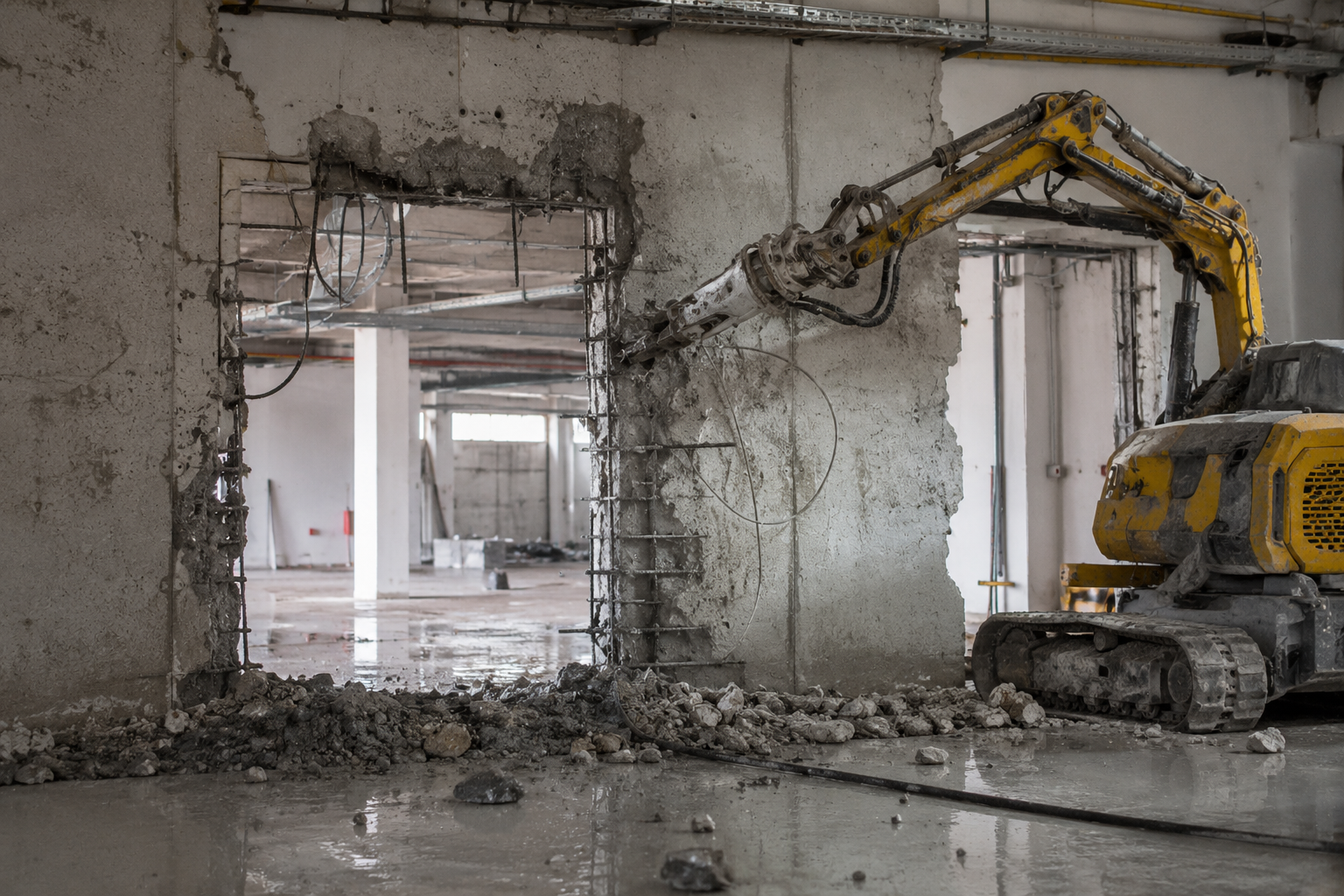
Demolition is often associated with large machines tearing down buildings or structures being removed in a matter of hours. While that type of demolition certainly exists, many projects require a far more controlled approach. In commercial buildings, industrial facilities, apartment complexes, warehouses, and renovation projects, it is often necessary to remove specific sections of a structure while leaving surrounding areas completely intact.
This is where controlled demolition becomes essential.
Controlled demolition is the process of carefully removing selected structural elements without causing unnecessary damage to adjacent structures, services, or occupied spaces. Rather than demolishing an entire building, the focus is on precision, planning, and maintaining the integrity of the remaining structure.
Whether the goal is to create a new opening, remove part of a slab, alter a structural wall, or prepare a building for renovation, controlled demolition allows these changes to be carried out safely and efficiently.
Understanding how controlled demolition works can help property owners, developers, contractors, and project managers make informed decisions when planning structural modifications.
Get a Controlled Demolition Quote for Your Project
Fill in the form below and receive a fast, no-obligation quote tailored to your demolition requirements.
Understanding Controlled Demolition
Controlled demolition involves the planned removal of specific structural elements while protecting surrounding areas from unnecessary damage. Unlike conventional demolition, which focuses on removing entire structures, controlled demolition is highly targeted and often forms part of a larger construction or renovation project.
The process typically begins with a detailed assessment of the structure. Contractors evaluate the existing conditions, identify load-bearing elements, assess access requirements, and determine the safest method of removal.
Every demolition project is different. A commercial office renovation may require the removal of a section of wall to create a larger workspace. A warehouse upgrade may require modifications to structural slabs. An apartment building may need openings created for new services or architectural changes.
In each case, the objective is not simply to remove concrete. The objective is to remove the correct section while preserving the surrounding structure and maintaining safety throughout the project.
Because of this precision, controlled demolition often involves a combination of demolition techniques, concrete cutting, wall sawing, and core drilling to achieve the desired result.
How Controlled Demolition Differs From Conventional Demolition
One of the biggest misconceptions about demolition is that all demolition projects are essentially the same.
In reality, controlled demolition and conventional demolition serve very different purposes.
Conventional demolition is generally used when an entire structure is being removed. The objective is to demolish the building as efficiently as possible while managing safety and environmental considerations.
Controlled demolition focuses on selective removal.
Instead of removing an entire building, contractors remove specific walls, slabs, beams, columns, staircases, or other structural components. The surrounding structure remains in place and often remains occupied or operational throughout the project.
This creates additional challenges.
Contractors must carefully consider structural stability, dust management, vibration control, noise restrictions, waste removal, and access limitations. Every stage of the work must be planned to avoid affecting areas that are intended to remain intact.
The result is a far more precise process that requires specialist knowledge, specialised equipment, and a detailed understanding of structural behaviour.
Where Is Controlled Demolition Used?
Controlled demolition is used in a wide range of industries and project types.
One of the most common applications is building renovations. Modernisation projects often require structural modifications to accommodate new layouts, services, or architectural features. Instead of demolishing the entire structure, specific sections are removed to support the new design.
Commercial buildings frequently require controlled demolition when office spaces are reconfigured or expanded. Retail centres may require alterations to improve customer flow or accommodate new tenants. Industrial facilities often need modifications to support upgraded equipment or production processes.
Controlled demolition is also commonly used during infrastructure upgrades. Bridges, tunnels, utility structures, and public facilities often require partial removal and reconstruction rather than complete replacement.
Residential projects can also benefit from controlled demolition. Homeowners carrying out major renovations may require structural walls removed, slabs altered, or extensions integrated into existing buildings.
In all of these situations, precision is more important than speed. The surrounding structure must remain protected while the required modifications are completed.
Why Precision Matters
Precision is what separates controlled demolition from more aggressive demolition methods.
Removing the wrong section of a wall, slab, or structural element can have serious consequences. Damage to adjacent structures can increase project costs, create delays, and introduce additional safety concerns.
For this reason, controlled demolition relies heavily on planning and accuracy.
Before work begins, contractors identify exactly what needs to be removed and how the removal will affect the remaining structure. Load paths are evaluated, reinforcement is considered, and removal methods are selected based on the specific project requirements.
Precision also reduces disruption.
Many controlled demolition projects take place inside occupied buildings where businesses continue operating throughout construction. Hospitals, office buildings, shopping centres, and industrial facilities often require demolition work to be carried out without significantly affecting daily operations.
The ability to remove specific structural elements while minimising disruption is one of the primary reasons controlled demolition has become such an important service within the construction industry.
Common Methods Used in Controlled Demolition
Controlled demolition is not a single technique. Instead, it involves selecting the most appropriate method for the structure being modified.
Depending on the project, contractors may use a combination of:
- Concrete cutting
- Wall sawing
- Floor sawing
- Core drilling
- Hydraulic bursting
- Hand demolition techniques
- Specialised demolition equipment
The chosen method depends on factors such as structural requirements, accessibility, reinforcement levels, vibration sensitivity, and project objectives.
For example, creating a precise opening within a reinforced concrete wall may involve wall sawing followed by selective demolition. Removing part of a slab may require floor sawing before concrete sections can be safely lifted out.
The objective is always the same: remove only what is necessary while preserving the integrity of the remaining structure.
Reinforced Concrete Often Increases Complexity
Many controlled demolition projects involve reinforced concrete structures.
While reinforced concrete provides excellent structural performance, it also increases the complexity of demolition work. Embedded steel reinforcement makes structures stronger and more resistant to removal, requiring additional planning and specialised equipment.
Projects involving reinforced walls, beams, columns, and slabs often require a combination of cutting and demolition techniques to achieve the desired result.
This is also one of the reasons reinforced concrete costs more to cut or core than standard concrete structures. The presence of reinforcement affects equipment wear, project duration, and overall complexity.
When reinforcement is present, precision becomes even more important. Contractors must carefully assess the structure before work begins to ensure that demolition activities do not compromise stability or create unintended consequences.
Safety Is Always the Highest Priority
Safety plays a central role in every controlled demolition project.
Unlike conventional demolition, where structures are being completely removed, controlled demolition often takes place within active environments. Workers, occupants, equipment, and surrounding structures may all be located close to the demolition area.
This requires comprehensive planning and risk management.
Potential hazards must be identified before work begins. Structural stability must be maintained throughout the demolition process, and appropriate safety measures must be implemented to protect both workers and the public.
Dust suppression, debris containment, access control, and equipment management all form part of the safety strategy.
Experienced contractors understand that successful demolition is not measured only by how quickly material is removed. It is measured by how safely and accurately the work is completed.
Need Accurate Pricing for Your Project?
Complete the form below and our team will provide expert guidance and a detailed estimate for your controlled demolition requirements.
What Influences the Complexity of a Controlled Demolition Project?
Not all controlled demolition projects are equally complex.
Several factors influence the planning, equipment requirements, and overall scope of work:
- Structural design
- Reinforcement levels
- Accessibility
- Occupied versus vacant buildings
- Size of the demolition area
- Waste removal requirements
- Safety considerations
- Engineering requirements
A relatively small demolition project inside a hospital may require significantly more planning than a larger project within an empty warehouse. Likewise, a heavily reinforced structural wall may present greater challenges than a larger non-structural element.
Understanding these factors helps explain why demolition projects can vary considerably in both complexity and cost.
Why Specialist Contractors Matter
Controlled demolition is not simply about removing concrete.
It requires an understanding of structural systems, demolition techniques, safety management, and project coordination. Every decision must consider both the element being removed and the structure that remains.
Experienced contractors bring the knowledge needed to identify risks, select appropriate methods, and complete work safely and efficiently.
They also understand how demolition activities interact with other construction processes. Controlled demolition is often only one stage of a larger project involving concrete cutting, drilling, structural modifications, and rebuilding.
The ability to coordinate these activities effectively contributes to smoother project delivery and better outcomes for property owners.
Understanding Controlled Demolition Starts With Understanding the Structure
Controlled demolition is one of the most important services used during renovations, structural alterations, and infrastructure upgrades. By focusing on precision rather than large-scale destruction, it allows contractors to remove specific sections of a structure while preserving surrounding areas.
The process requires detailed planning, specialised equipment, and a strong understanding of structural behaviour. Factors such as reinforcement, accessibility, safety requirements, and engineering considerations all play an important role in determining how demolition work is carried out.
Many projects that involve controlled demolition also require careful budgeting. Understanding controlled demolition costs in Johannesburg before construction begins can help property owners plan more effectively and avoid unexpected surprises later in the project.
When performed correctly, controlled demolition creates opportunities for renovation, expansion, and structural improvement while maintaining the integrity of the existing building.
Request Your Free Controlled Demolition Quote
Fill in the form below and receive professional advice and accurate pricing tailored to your project requirements.