
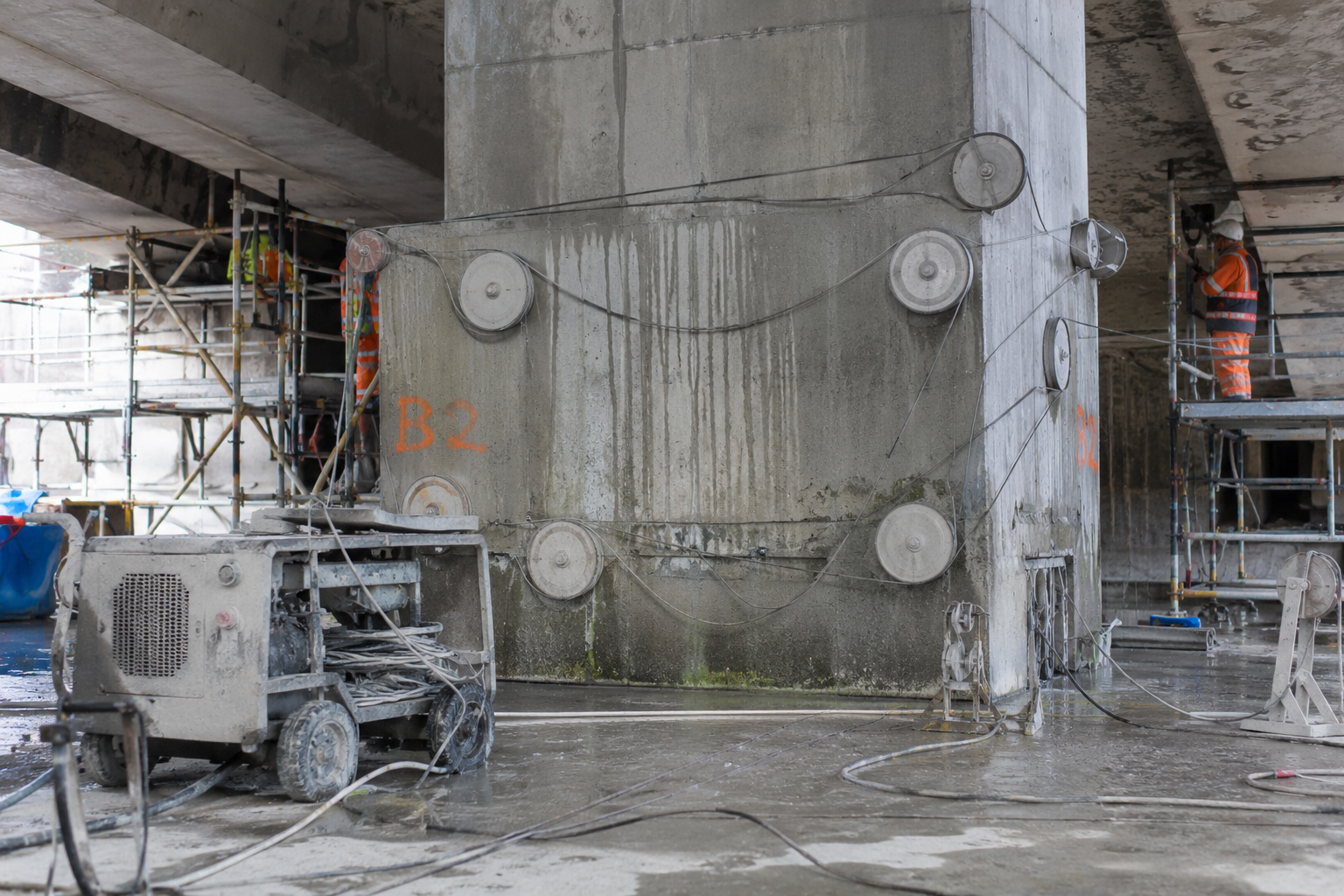
Concrete cutting technology has evolved significantly over the years, making it possible to modify even the largest and most heavily reinforced structures with remarkable precision. While many people are familiar with methods such as wall sawing, floor sawing, and core drilling, fewer are aware of one of the most powerful concrete cutting techniques available: wire sawing.
Wire sawing is a specialised cutting method used when conventional cutting equipment is unable to complete the task efficiently. It is commonly used on large concrete structures, heavily reinforced elements, thick walls, bridges, foundations, and industrial infrastructure where standard saws reach their practical limits.
For property owners and project managers, wire sawing often becomes necessary when a project involves substantial structural modifications. Whether the objective is to remove part of a bridge, alter a large foundation, create openings within thick concrete structures, or dismantle industrial equipment bases, wire sawing provides a precise and controlled solution.
Understanding what wire sawing is and when it is used can help explain why it plays such an important role in modern construction, demolition, and infrastructure projects.
Discuss Your Wire Sawing Project With Our Team
Fill in the form below and receive professional advice and a no-obligation quotation tailored to your project requirements.
What Is Wire Sawing?
Wire sawing is a concrete cutting technique that uses a continuous loop of diamond-impregnated wire to cut through concrete, reinforced concrete, steel, masonry, and other hard construction materials.
Unlike traditional saws that use a circular blade, wire sawing relies on a flexible cable fitted with diamond segments. The wire is threaded around the structure being cut and then driven by a hydraulic or electric system. As the wire moves continuously around the object, the embedded diamonds grind through the material with exceptional precision.
Because the wire is flexible, it can cut structures that would be impossible to reach using conventional saws. This makes wire sawing one of the most versatile cutting methods available in the construction industry.
The process is particularly effective when working with extremely thick concrete elements, heavily reinforced structures, or unusual shapes where traditional cutting equipment cannot operate efficiently.
How Wire Sawing Works
The process begins by establishing access around the section that needs to be removed. Small access holes are often drilled to allow the wire to be threaded through the structure.
Once the wire has been positioned correctly, it is connected to a drive system that maintains constant tension while moving the wire at high speed. Water is typically introduced during cutting to cool the wire and minimise dust generation.
As the diamond wire travels continuously around the structure, it gradually cuts through the material. Because the cutting action is based on abrasion rather than impact, vibration levels remain relatively low compared to many demolition methods.
One of the major advantages of wire sawing is that the cutting depth is not limited by the diameter of a blade. This allows contractors to cut through structures that may be several metres thick, making wire sawing suitable for some of the most demanding projects in the industry.
The process requires careful planning, accurate setup, and experienced operators to ensure safe and efficient execution.
When Is Wire Sawing Used?
Wire sawing is generally selected when conventional cutting methods are no longer practical.
Many construction and demolition projects involve concrete structures that exceed the capabilities of standard wall saws or floor saws. In these situations, wire sawing often becomes the preferred solution.
Common examples include bridge modifications, dam maintenance projects, large foundations, industrial equipment bases, marine structures, retaining walls, and heavily reinforced concrete elements.
Wire sawing is also frequently used when sections of concrete need to be removed intact rather than broken into smaller pieces. This is particularly important when surrounding structures must remain undamaged or when vibration needs to be minimised.
Infrastructure projects often rely on wire sawing because many structures are simply too large for conventional cutting equipment. The ability to cut thick concrete accurately while maintaining structural control makes wire sawing an invaluable technique for these applications.
Why Not Use a Wall Saw or Floor Saw?
A common question is why contractors would choose wire sawing instead of more familiar methods such as wall sawing or floor sawing.
The answer usually comes down to size and accessibility.
Wall sawing is highly effective for creating openings in vertical concrete structures. Floor sawing is ideal for cutting horizontal surfaces such as slabs and pavements. However, both methods have practical limitations.
As structures become thicker, larger, or more heavily reinforced, conventional saws may no longer provide an efficient solution.
Wire sawing overcomes these limitations because the wire can be routed around large sections of concrete rather than relying on a fixed blade depth.
For example, while wall sawing is often used for creating door and window openings, wire sawing may be required when an entire structural section needs to be removed from a bridge pier, foundation block, or heavily reinforced wall.
The two methods are not competitors. They are complementary technologies used for different applications.
Common Applications for Wire Sawing
Wire sawing is used across a wide range of industries because of its ability to handle challenging structures.
Some of the most common applications include:
- Bridge modifications and bridge demolition
- Dam maintenance and upgrades
- Large foundation removal
- Industrial plant modifications
- Structural alterations to heavily reinforced buildings
- Removal of thick concrete walls
- Marine and harbour structures
- Power generation facilities
Although these projects vary considerably, they all share one characteristic: the structures involved are typically too large, too thick, or too heavily reinforced for conventional cutting methods.
Wire sawing provides a practical way to complete these modifications while maintaining accuracy and control.
The Advantages of Wire Sawing
One of the biggest advantages of wire sawing is its ability to cut virtually any thickness of concrete.
Unlike traditional saws, cutting depth is not restricted by blade diameter. This makes wire sawing suitable for projects involving massive concrete structures.
Another advantage is its ability to cut heavily reinforced concrete. Many large structures contain dense reinforcement that would make alternative methods slower or less effective.
Wire sawing also offers excellent precision. Contractors can make highly accurate cuts while maintaining control over the sections being removed.
Reduced vibration is another significant benefit. Many structures cannot tolerate excessive vibration due to structural sensitivity or the presence of nearby equipment and occupants. Wire sawing provides a controlled cutting method that minimises these concerns.
The technique also generates cleaner cuts than many demolition methods, reducing the amount of additional work required after removal.
Why Wire Sawing Is Often Used With Other Services
Wire sawing is rarely performed in isolation.
Many projects combine wire sawing with core drilling, wall sawing, concrete cutting, and controlled demolition techniques to achieve the desired outcome.
For example, core drilling may be used to create access holes for the wire. Wall sawing may be used to create initial openings. Controlled demolition techniques may then be used to remove the cut sections safely.
Large structural modification projects often involve several specialised services working together.
This is one reason why major structural alterations can influence overall concrete cutting costs in Johannesburg. The complexity of these projects frequently requires multiple cutting and demolition techniques rather than a single solution.
Need Expert Advice on a Complex Cutting Project?
Fill in the form below and our team will assess your project requirements and recommend the most effective cutting solution.
Why Reinforced Concrete Creates Additional Challenges
Many wire sawing projects involve heavily reinforced concrete structures.
Reinforcement provides strength and durability, but it also increases the complexity of cutting operations. Dense reinforcement layouts place greater demands on equipment and can increase project duration.
Large industrial structures, bridges, foundations, and infrastructure assets often contain significant amounts of reinforcement. In these situations, specialist cutting methods become essential.
This is also one of the reasons why reinforced concrete costs more to cut or core than standard concrete structures. The additional equipment wear, planning, and cutting time required all contribute to overall project complexity.
Understanding the role of reinforcement is important when evaluating large structural modification projects.
Why Specialist Contractors Matter
Wire sawing is one of the most specialised services within the concrete cutting industry.
The equipment itself is highly specialised, but successful projects depend on much more than machinery. Contractors must understand structural behaviour, cutting sequences, load management, safety procedures, and section removal techniques.
Improper planning can create significant risks, particularly when large structural sections are being removed.
Experienced contractors assess the structure carefully before work begins. They determine how the cuts should be performed, how removed sections will be supported, and how surrounding structures will be protected throughout the process.
The larger the structure becomes, the more important experience and planning become.
Understanding Wire Sawing Starts With Understanding the Project
Wire sawing is one of the most effective solutions available for cutting large, thick, and heavily reinforced concrete structures. While it is less commonly used than wall sawing or floor sawing, it plays a critical role in projects where conventional cutting methods reach their limits.
Its ability to cut massive structural elements with precision makes it invaluable for infrastructure projects, industrial facilities, major renovations, and structural modifications.
Projects involving wire sawing are often complex and require careful planning from the outset. In many cases, they also form part of broader structural alterations, making them an important consideration when budgeting for concrete alterations on renovation projects.
By understanding what wire sawing is and when it is used, property owners and project managers can make more informed decisions when planning large-scale concrete modification projects.
Request Your Free Wire Sawing Quote
Fill in the form below and receive professional advice and accurate pricing tailored to your wire sawing project requirements.